Key Takeaways
- AI SEO helps websites become easier for AI-powered search platforms to understand and reference.
- Traditional SEO still matters, but AI search also focuses on context, relevance, trust, and clear answers.
- Businesses can improve AI visibility through helpful content, technical SEO, strong website structure, and authority.
- ChatGPT, Gemini, Perplexity, and Google AI Overviews use different systems, so rankings or mentions cannot be guaranteed.
- A strong AI SEO strategy can help businesses gain visibility across both traditional and AI-powered search experiences.
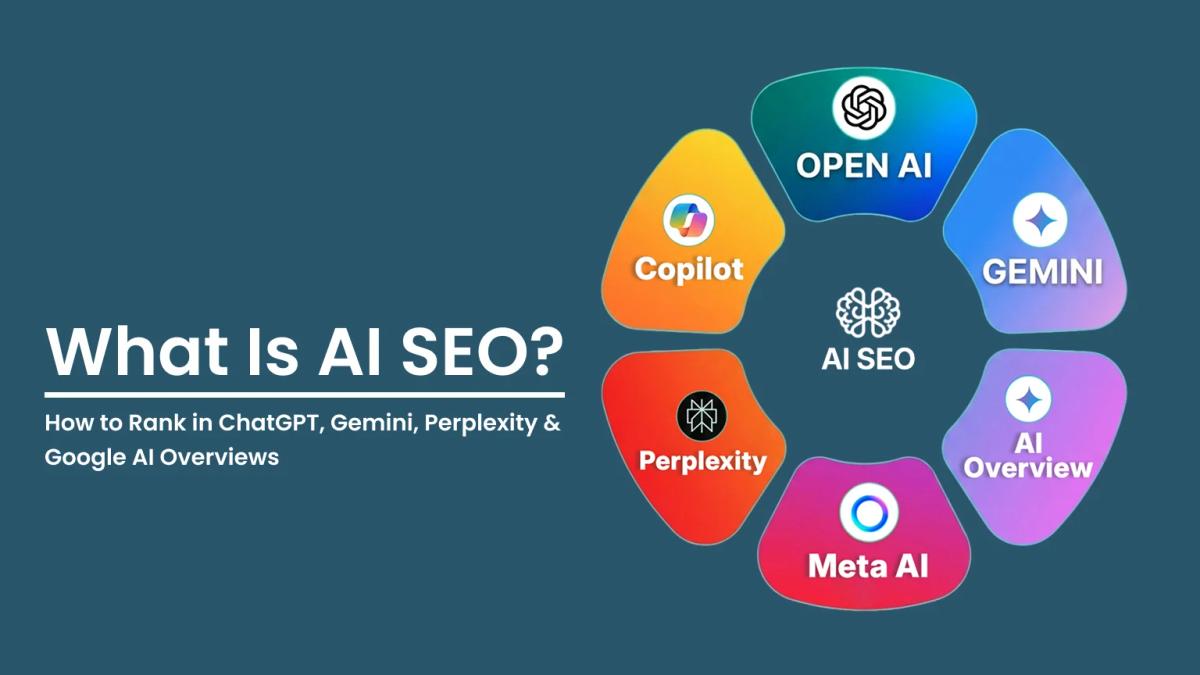
What Is AI SEO? How to Rank in ChatGPT, Gemini, Perplexity & Google AI Over
AI SEO is the process of optimizing your website and content so AI-powered search platforms can understand, trust, and use your information in their answers. It helps businesses improve visibility in tools such as ChatGPT, Gemini, Perplexity, and Google AI Overviews. Unlike traditional SEO, the goal is not only to appear as a blue link but also to become a useful source that AI systems may reference when answering user questions.
AI SEO combines strong content, clear website structure, relevant entities, factual information, technical SEO, and trusted sources. It focuses on answering real
questions clearly while making important information easy for both search engines and AI systems to understand.
In this guide, you will learn how AI SEO works, how ChatGPT, Gemini, Perplexity, and Google AI Overviews select information, and which practical steps can help your website gain more visibility across these AI search experiences.
What Is AI SEO?
AI SEO is the process of optimizing your website and content so AI-powered search platforms can understand, trust, and use your information in their answers. It helps businesses improve visibility in tools such as ChatGPT, Gemini, Perplexity, and Google AI Overviews. Unlike traditional SEO, the goal is not only to appear as a blue link but also to become a useful source that AI systems may reference when answering user questions.
AI SEO combines strong content, clear website structure, relevant entities, factual information, technical SEO, and trusted sources. It focuses on answering real questions clearly while making important information easy for both search engines and AI systems to understand.
In this guide, you will learn how AI SEO works, how ChatGPT, Gemini, Perplexity, and Google AI Overviews select information, and which practical steps can help your website gain more visibility across these AI search experiences.
How Does AI SEO Work?
AI SEO works differently from a single ranking algorithm. Instead of one system, you're optimizing for several separate models, each with its own way of retrieving, evaluating, and summarizing content. Most of these systems rely on a mix of live web crawling, indexed data, and pre-trained knowledge, then generate a conversational answer instead of a list of links.
At a technical level, this falls under a broader practice known as AI search optimization - the discipline of shaping content so language models can parse it accurately, extract the right facts, and attribute them to your brand. Some practitioners call this SEO for AI search, while others use the term AI-powered search optimization to describe the same underlying goal: getting cited, not just crawled.
You'll also hear this called generative engine optimization, or GEO for short. Generative Engine Optimization (GEO) focuses specifically on how generative AI tools construct answers, which sources they pull from, and how content should be formatted so it survives the summarization process. A closely related term, answer engine optimization (often shortened to AEO), applies to tools designed to give direct answers rather than search results - think featured snippets, voice assistants, and chat-based search.
In practice, AI SEO works through three layers:
1. Crawlability and Indexing
AI tools need to access your pages the same way traditional crawlers do. If your site blocks bots, loads content only through JavaScript without fallback HTML, or lacks a clean sitemap, models simply won't find you.
2. Content Structure and Extractability
AI systems favor content that's easy to lift and reuse - clear headings, direct answers near the top of a section, and well-organized lists. Dense paragraphs with no structure are harder for models to parse into a clean citation.
3. Trust and Verification Signals
Models weigh authorship, citations, consistency across the web, and factual accuracy. A page repeated accurately across multiple trusted sources is more likely to be treated as a reliable answer.
AI SEO vs Traditional SEO
Traditional SEO and AI SEO share a foundation - both need crawlable pages, relevant keywords, and authoritative backlinks. But the objectives diverge in meaningful ways.
Traditional SEO optimizes for rankings on a results page. Success is measured by position, click-through rate, and organic traffic. The user sees ten blue links and chooses where to click.
AI SEO optimizes for being the source behind an answer. The user often never clicks through - they read a synthesized response and move on. Your win condition shifts from "rank #1" to "get cited, quoted, or paraphrased accurately."
| Factor | Traditional SEO | AI SEO |
|---|---|---|
| Goal | Rank on search results page | Get cited inside AI-generated answers |
| Measured by | Position, CTR, traffic | Citations, mentions, brand recall in AI answers |
| Content format | Keyword-optimized pages | Structured, extractable, fact-dense content |
| User outcome | Click to website | Read answer, may not visit site |
| Trust signals | Backlinks, domain authority | Backlinks + consistency across the web, entity clarity |
This also changes how AI search results get evaluated. A page can rank on page one of Google yet never appear inside an AI Overview or a ChatGPT response, because the extraction criteria aren't identical to classic ranking factors. Businesses now need both: strong AI search engine optimization to be found by traditional crawlers, and structural clarity so the same content survives AI summarization.
Why AI SEO Matters for Businesses in 2026
More people are starting their research inside a chat window instead of a search bar. Product comparisons, "best of" lists, troubleshooting steps, and even purchase decisions increasingly happen through an AI assistant that summarizes multiple sources into one answer.
This shift has real business consequences:
- Zero-click discovery is rising. Users get their answer without visiting a site, which means your brand's visibility now depends on being inside the answer, not just linked below it.
- Trust compounds across platforms. A brand mentioned consistently and accurately across ChatGPT, Gemini, Perplexity, and Google AI Overviews builds a reputation signal that's hard for competitors to displace once established.
- Early movers get an advantage. Since AI search rankings are less saturated than traditional keyword rankings, businesses investing in AI SEO optimization now often see outsized visibility compared to what the same effort would produce in classic SEO.
- AI-driven referral traffic is a new channel. Even without a click, being cited by name builds brand recall, and brand searches convert at a higher rate than cold traffic.
Ignoring this shift doesn't make it disappear - it just means competitors who invest in AI search marketing now will own the answer space by the time it becomes mainstream practice.
How to Rank in ChatGPT
ChatGPT primarily draws from a mix of licensed data, browsing results (when enabled), and its trained knowledge. Wanting to know how to rank in ChatGPT means understanding that it doesn't "rank" pages the way Google does - it selects and paraphrases the clearest, most consistent, most well-cited information it can find.
How ChatGPT Decides What to Cite
When ChatGPT browses the web, it favors pages with direct answers near the top, clear author attribution, and information that matches what's already been repeated elsewhere. If you want to rank in ChatGPT, structure your most important facts in the first two or three sentences of a section rather than burying them under a long introduction.
Building a ChatGPT SEO Strategy
A solid ChatGPT SEO strategy starts with entity clarity - make sure your brand, products, and expertise are described the same way across your site, your social profiles, and third-party mentions. This consistency is central to ChatGPT search optimization, since the model cross-references multiple sources before trusting a claim.
Practical steps to optimize content for ChatGPT include:
- Writing direct, quotable definitions early in each section
- Using structured data (FAQ schema, HowTo schema) so key facts are easy to extract
- Publishing on platforms ChatGPT frequently references, including forums, review sites, and industry publications
- Keeping factual claims consistent site-wide to avoid contradictory signals
ChatGPT SEO also rewards freshness. Pages updated with current statistics and dates tend to outperform stale content when the model is choosing between similar sources. Improving your ChatGPT visibility and ChatGPT search rankings is less about one page and more about how your entire web presence supports the same set of facts. And when you're chasing how to get cited by ChatGPT specifically, the safest bet is writing content that could be lifted and quoted without needing extra context - self-contained, factual, and clearly attributed.
How to Rank in Google AI Overviews
Google AI Overviews SEO builds directly on your existing search rankings, since Overviews pull heavily from pages that already perform well in traditional organic results. If you're asking how to rank in Google AI Overviews, the starting point is the same technical foundation you'd use for classic SEO - fast load times, mobile usability, and clean indexing.
AI Overviews Ranking Factors
The main AI Overviews ranking factors include topical authority, structured content, schema markup, and how directly a page answers a specific query. Google's system tends to pull short, well-defined answer blocks rather than long narrative paragraphs, so breaking content into scannable sections with a clear answer at the top of each one is essential.
Practical Steps to Appear in AI Overviews
To optimize for Google AI Overviews, focus on:
- Structuring content around question-based H2s and H3s that mirror real search queries
- Including up-to-date statistics, dates, and named sources
- Adding FAQ, Article, and HowTo schema to help Google parse content into extractable snippets
- Earning mentions from other authoritative sites, since Google AI search optimization still leans on external validation, not just on-page signals
A strong Google AI Overview optimization approach treats every page as a potential answer card - assume Google might lift a single paragraph out of context, and write that paragraph so it stands on its own. Businesses that want to consistently appear in Google AI Overviews should treat this as an extension of their existing Google AI Overviews SEO strategy, not a separate project, since improving one often lifts the other. The end goal is durable AI Overview visibility across a growing share of your target queries.
How to Rank in Gemini
Gemini draws heavily on Google's search index along with its own training data, so many of the same principles from Google AI Overviews apply here too. If you're researching how to rank in Gemini, start by strengthening the technical and structural fundamentals that already support your Google visibility.
Gemini SEO places extra weight on multimodal clarity - image alt text, video transcripts, and structured product data all feed into how Gemini interprets a page. Since Gemini is deeply integrated with Google Gemini optimization practices already used across Google Search and Workspace tools, aligning your content with Google's broader entity and schema guidelines pays off across multiple surfaces at once.
To optimize content for Gemini effectively:
- Use descriptive, keyword-relevant alt text and captions on all media
- Structure long-form content with clear headings that map to specific user questions
- Maintain consistent brand and product descriptions across your site and third-party listings
- Keep statistics and claims current, since Gemini favors recently verified information
Gemini search optimization also benefits from strong internal linking, since Gemini appears to reward sites where related information is easy to traverse and cross-reference. Improving your Gemini visibility is largely about reinforcing the same signals Google already values, then adding the extra layer of media and structural clarity Gemini specifically weighs. For businesses wondering how to appear in Gemini answers consistently, the safest strategy is simply doubling down on structured, well-labeled, and frequently updated content.
How to Rank in Perplexity
Perplexity operates more like a research assistant than a traditional search engine, citing multiple sources directly inside its answers with visible footnotes. Learning how to rank in Perplexity means understanding that it actively rewards pages with clear factual density and transparent sourcing.
Perplexity SEO favors content that reads like a well-organized reference document rather than a marketing page. Because Perplexity shows its sources openly, it tends to select pages that are unambiguous, well-cited themselves, and free of vague marketing language.
What Improves Perplexity Search Optimization
Perplexity search optimization responds well to:
- Original data, statistics, or research that other sites don't already have
- Clear author bios and credentials, since Perplexity weighs source credibility visibly
- Direct, single-sentence answers to specific questions, placed early in each section
- Regularly refreshed content, since Perplexity appears to favor recency for time-sensitive topics
If you want to optimize content for Perplexity, avoid burying facts inside long introductions or promotional framing - Perplexity's citation style rewards content that reads as neutral and informative. Building Perplexity visibility over time also depends on being mentioned across independent, high-authority sites, since Perplexity often triangulates multiple sources before settling on an answer. A focused Perplexity SEO strategy that prioritizes originality and transparent sourcing tends to outperform generic content, and it's often the fastest route to actually get cited by Perplexity on competitive topics.
Key AI SEO Strategies to Improve Your Visibility
A strong AI SEO strategy doesn't require reinventing your content operation - it requires layering AI-specific structure on top of what already works.
Build Topical Authority, Not Just Pages
Publishing scattered articles rarely earns citations. AI systems favor sites that clearly own a subject area, so grouping related content into clusters - with strong internal linking between them - signals depth that single, isolated pages can't.
Apply Structured Data Everywhere It's Relevant
Schema markup remains one of the most reliable AI SEO techniques, since it gives models an explicit, machine-readable version of your content instead of forcing them to infer meaning from prose.
Strengthen Entity Consistency
Your brand name, founder credentials, and core claims should be read identically across your website, social profiles, directories, and press mentions. This consistency directly supports AI search visibility, since models cross-check facts across multiple sources before trusting them.
Treat GEO as Its Own Discipline
GEO SEO work - writing specifically for how generative engines summarize content - deserves its own editorial checklist separate from classic keyword optimization, since the two don't always overlap perfectly.
Invest in LLM-Specific Optimization
LLM optimization includes things like publishing clear glossary-style definitions, using consistent terminology, and avoiding ambiguous phrasing that could be misparsed or misattributed when a model paraphrases your content.
How to Optimize Content for AI Search
Practical execution matters more than theory here. If your goal is to optimize for AI search, treat every page as if a machine will read only the first few lines of each section and decide whether to use it.
Start with the structure:
- Lead with the answer. Put the direct response to the implied question in the first one to two sentences of each section.
- Use descriptive headings. Match H2s and H3s to how people actually phrase questions, not internal jargon.
- Keep facts verifiable. Cite sources, include dates, and avoid vague superlatives without backing data.
- Format for extraction. Use bullet points, numbered steps, and tables wherever comparison or sequence is involved.
This overall approach to search optimization for AI works best when paired with ongoing technical maintenance - broken links, outdated statistics, and inconsistent claims all erode the trust signals models rely on. LLM SEO in particular benefits from a "one fact, one clear statement" writing style, since models tend to struggle with content that hedges or contradicts itself across a page.
Expert insightExpert Insight: Based on reviewing dozens of pages that consistently get cited across AI platforms, the pattern is rarely about keyword density. It's almost always about clarity - content that states a fact plainly, backs it with a source, and moves on, without wrapping the answer in unnecessary framing.
What Types of Content Perform Well in AI Search?
Not every content format performs equally well once you shift focus toward AI systems instead of purely human readers.
Definitional and Glossary Content
Short, precise definitions are among the easiest content types for AI models to extract and quote directly, making them a reliable source of citations.
Comparison and "Versus" Content
Structured comparisons - feature by feature, product by product - translate cleanly into tables and lists that AI systems can summarize accurately.
Original Research and Data
Statistics you've generated yourself, rather than recycled from other sites, are disproportionately valuable because models actively look for a primary source to cite.
Step-by-Step Guides
Numbered processes with a clear beginning and end are easy for AI systems to represent faithfully without losing meaning.
FAQ-Style Content
Question-and-answer formatting mirrors how users phrase prompts to AI tools, making this AI-friendly content format especially effective for matching real queries.
Across all of these formats, the common thread is structural clarity. Improving your LLM visibility isn't about writing more content - it's about making the content you already have easier for a model to lift accurately.
AI SEO Checklist
Use this as a working checklist when auditing or building content for AI visibility:
- Content answers the core question within the first two sentences of each section
- Headings are phrased as natural questions where relevant
- FAQ, Article, and HowTo schema are implemented where applicable
- Brand, product, and author information is consistent across all platforms
- Statistics and claims are current and properly sourced
- Internal linking connects related topics into clear clusters
- Media includes descriptive alt text and captions
- Site is fully crawlable, with no critical content locked behind JavaScript-only rendering
- Original data or research is included where possible
- Content is reviewed and refreshed on a regular schedule
Improve Your AI Search Visibility with CodedSEO?
Implementing an AI SEO strategy across ChatGPT, Gemini, Perplexity, and Google AI Overviews takes more than a checklist - it takes ongoing structural work, content refreshes, and technical monitoring most in-house teams don't have time for. This is where a specialized agency like CodedSEO, a digital marketing agency for small businesses and startups with more than 5+ years of experience, can help.
Our dedicated AI SEO service covers the exact platforms discussed in this guide, including specific offerings for ChatGPT SEO, Google AI Mode, Perplexity SEO, Generative Engine Optimization, and AEO - so businesses can get platform-specific strategy instead of a one-size-fits-all approach.
If you'd rather have specialists handle the technical structuring, schema implementation, and cross-platform consistency work outlined in this guide, you can explore our AI SEO services or request a free consultation directly through our website.
Add CodedSEO as a preferred source on Google
Get CodedSEO content more easily when researching AI SEO and search trends.
Is Your Website Ready for AI Search?
Build a search strategy that combines technical SEO, helpful content and AI search optimization to improve your visibility across modern search experiences.
Talk to CodedSEO Experts →Frequently Asked Questions
AI SEO is the process of improving your website and content so AI-powered search systems can understand and use your information. It focuses on useful content, clear structure, technical SEO, authority, and relevant information to improve your chances of being discovered or referenced in AI-generated answers.
Traditional SEO mainly focuses on improving rankings in search engine results. AI SEO also considers how AI systems understand, summarize, and reference information. It focuses more on conversational questions, context, entities, content quality, and brand visibility across AI-powered search experiences.
No, rankings or mentions in AI search cannot be guaranteed. AI platforms use different systems and factors to select information. Businesses can improve their chances by creating accurate, useful, trustworthy content, maintaining strong technical SEO, and making important website information easy to understand.
Start by creating helpful content that directly answers customer questions. Improve your technical SEO, website structure, internal linking, and content accuracy. Add original insights, maintain consistent business information, and build relevant authority. Regularly update important pages to keep information useful and current.
Yes, traditional SEO remains important. Technical accessibility, quality content, website structure, authority, and relevant search visibility can support AI search performance. AI SEO should work alongside traditional SEO rather than replace it, creating a stronger overall search strategy for both conventional and AI-powered search experiences.
Useful, clear, and trustworthy content can perform well across AI search experiences. Detailed guides, original research, comparisons, case studies, FAQs, expert content, and data-driven articles are valuable formats. The content should answer real questions, provide useful context, and include accurate information that users can trust.
There is no fixed timeframe for AI SEO results. Visibility can depend on your website's current authority, content quality, technical health, competition, and how AI platforms discover information. Consistent content improvements, technical optimization, and authority building can create stronger long-term opportunities.
Yes, businesses should consider AI SEO as part of their broader search strategy. People are increasingly using AI-powered tools to research and compare information. Improving your website for these experiences can create additional opportunities for brand visibility while supporting your existing organic search efforts.